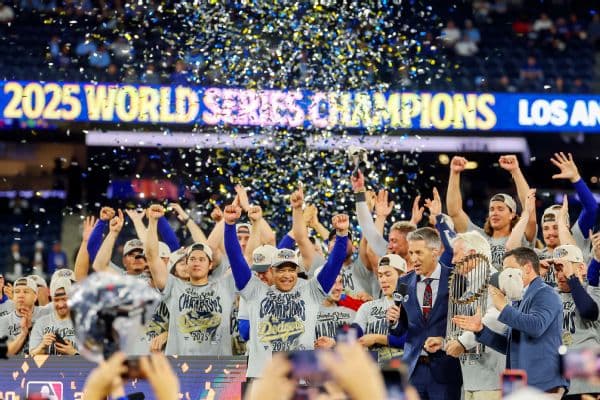
The Los Angeles Dodgers have long been the financial juggernauts of Major League Baseball, but the 2025 season saw the franchise enter a stratosphere of its own. According to official league figures, the Los Angeles Dodgers smashed the Dodgers MLB spending record by reaching a combined total of $515 million in payroll and luxury tax payments. This staggering figure marks the first time in the history of the sport that a single team has crossed the half-billion-dollar threshold for a single season of operation.
A Historic Milestone: Breaking Down the Dodgers MLB Spending Record
The $515 million total is not just a payroll figure; it is a combination of player salaries and the heavy penalties associated with the league's Competitive Balance Tax (CBT). For the 2025 season, the Dodgers operated with a base payroll that already led the league, but their status as a "repeat offender" under the current Collective Bargaining Agreement significantly amplified their financial obligations. By exceeding the luxury tax thresholds for multiple consecutive years, the Dodgers are subject to the highest possible tax rates, often referred to as the "Steve Cohen tax" tiers.
This "tax on a tax" is designed to discourage runaway spending and maintain parity, yet the Los Angeles front office has demonstrated a unique willingness to absorb these costs to maintain a championship-caliber roster. The $515 million figure represents a seismic shift in how elite franchises value the intersection of talent acquisition and financial flexibility. It sends a clear message to the rest of the league: the Dodgers view these penalties as a secondary concern compared to the pursuit of World Series titles.
The Financial Landscape: Dodgers vs. the Rest of the League
To put the Dodgers' record-breaking year into perspective, one only needs to look at the other end of the financial spectrum. While the Dodgers were committing over half a billion dollars to their 2025 campaign, teams like the Miami Marlins operated on a fraction of that budget. In many recent seasons, the entire payroll of the Marlins has hovered around or below the amount the Dodgers paid just in luxury tax penalties alone. This widening gap between the "haves" and the "have-nots" continues to be a central talking point within MLB circles.
The disparity is highlighted by several key factors:
- The Dodgers' luxury tax bill alone exceeded the total payroll of several small-market franchises.
- The $515 million total is higher than the combined payrolls of the bottom four or five teams in the league.
- The Dodgers' ability to leverage massive local television revenue and global branding allows them to sustain this level of spending, a feat that is mathematically impossible for teams like the Marlins under the current economic structure.
How the Dodgers Reached the $515 Million Mark
Several factors contributed to this record-shattering total. The Dodgers' roster features some of the most lucrative contracts in sports history, including the unique structure of Shohei Ohtani's deal. While Ohtani's contract includes significant deferrals, the "present value" calculation used for luxury tax purposes still adds a substantial hit to the team's annual CBT figure. When combined with the high-market salaries of stars like Yoshinobu Yamamoto, Mookie Betts, and Freddie Freeman, the baseline was already set at a historic level.
Furthermore, the Dodgers' aggressive approach at the trade deadline and in the free-agent market for mid-tier depth and pitching reinforcements added millions to the final tally. Every dollar added to the payroll for a team this far over the threshold results in nearly double the actual cost due to the 110% surcharge on spending in the highest tax tier. This means that a late-season acquisition earning $5 million actually costs the Dodgers over $10 million when the tax man comes calling.
The Future of MLB's Economic Landscape
The Dodgers' $515 million season sets a new benchmark that other high-spending teams, such as the New York Mets and New York Yankees, will likely be compared against for years to come. It challenges the effectiveness of the current luxury tax system as a "hard cap," proving that for a franchise with enough revenue, the penalties are simply a cost of doing business rather than a deterrent. As MLB looks toward future labor negotiations, the Dodgers' 2025 spending will undoubtedly be a primary exhibit in discussions regarding a potential salary floor or more restrictive spending caps.
For now, the Dodgers remain the gold standard of financial aggression in professional sports. They have proven that they are willing to navigate the complexities of the CBT and pay record-breaking sums to keep a superstar core intact. Whether this level of spending becomes the new normal for elite teams remains to be seen, but for 2025, the Dodgers have officially rewritten the record books.
Sources & Original Reporting