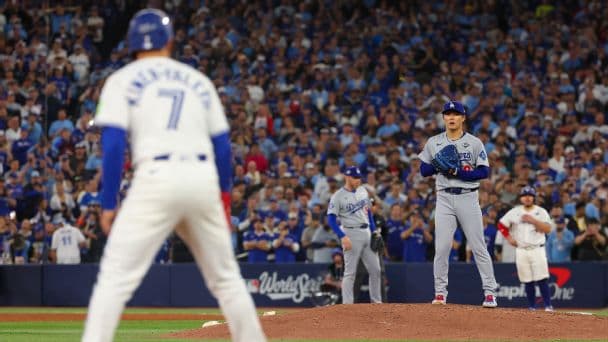
In the high-stakes environment of professional baseball, the difference between a postseason celebration and a long winter of regret often boils down to a single step. For the Toronto Blue Jays, that realization was cemented in one of the most painful moments in recent franchise history: the pick-off of Vladimir Guerrero Jr. during the 2023 AL Wild Card Series. As Toronto concludes its latest series against the Los Angeles Dodgers in April 2026, the spotlight has returned to a fundamental yet frequently overlooked aspect of the game: the technical precision of MLB baserunning leads. It is a skill that veteran analyst Tim Kurkjian argues is currently in a state of flux across the league.
The 2023 AL Wild Card: A Costly Lesson in Fundamentals
The heartbreak of the 2023 postseason still serves as the primary case study for why baserunning is a discipline of inches. During Game 2 against the Minnesota Twins, with the Blue Jays trailing and a rally brewing, Vladimir Guerrero Jr. was caught off second base by a snap throw from Sonny Gray. The play effectively ended Toronto's momentum and, ultimately, their season. While fans often focus on home runs and strikeout rates, that moment served as a stark reminder that MLB baserunning leads are a weapon that can just as easily be turned against the runner.
When a runner fails to gain the proper distance or miscalculates the pitcher’s delivery, it ripples through the entire offense. A lead that is six inches too short can be the difference between being safe or out on a close play at second, or more importantly, the difference between scoring from second on a single or being held up by the third-base coach. For Toronto, those inches in 2023 were the distance between a potential deep run and an early exit.
The Mechanics of Effective MLB Baserunning Leads
Taking a lead is far more than just walking away from the bag. It is a calculated risk involving physics, psychology, and reaction time. According to Kurkjian’s exploration of the craft, elite baserunners focus on several key pillars to maximize their efficiency:
- The Primary Lead: The initial distance taken before the pitcher begins their delivery, measured to the precise inch where a runner can still return safely on a pick-off attempt.
- The Secondary Lead: The two or three aggressive shuffles a runner takes as the ball enters the hitting zone, providing the momentum needed to sprint if the ball is put in play.
- The "Read": Identifying the pitcher’s "tell"—a twitch of the shoulder, a lift of the heel, or a specific glove movement—that signals a move to the plate rather than a throw to the bag.
The modern game has seen a resurgence in the importance of these leads due to the implementation of the pitch clock and limited pick-off attempts. Runners now have a mathematical advantage, but as history has shown, that advantage is only useful if the fundamentals are sound and the timing is perfect.
Isiah Kiner-Falefa: A Master of the Small Game
Amidst the technical breakdown of the skill, Isiah Kiner-Falefa stands out as a primary example of how to execute these fundamentals at the highest level. Since joining the Blue Jays, Kiner-Falefa has built a reputation not just for his versatility, but for his intelligence on the paths. He understands that MLB baserunning leads are about more than just stealing bases; they are about putting constant pressure on the pitcher and the defense.
Kiner-Falefa’s approach involves a meticulous study of opposing pitchers. By maximizing his lead without crossing the "point of no return," he forces pitchers to divide their attention between the hitter and the runner. This distraction often leads to more fastballs for the batter or defensive lapses in the infield. In the current series against the Los Angeles Dodgers, Kiner-Falefa’s ability to "cheat" an extra few inches has been a focal point for scouts, showcasing why he remains one of the most effective baserunners in the league.
Why the Art of the Lead is Disappearing
Despite its importance, many veterans and coaches worry that the art of the lead is becoming a lost skill. In an era dominated by "three true outcomes"—home runs, walks, and strikeouts—the focus on manufacturing runs through aggressive baserunning has occasionally taken a backseat. However, as the Blue Jays learned the hard way, when the power bats go quiet in the postseason, the outcome rests on the shoulders of the baserunners.
The Toronto Blue Jays have spent the seasons since that 2023 blunder ensuring that the mistakes of the past do not become a recurring theme. By emphasizing the technical nuances of the game, they hope to transform their baserunning from a potential liability into a consistent weapon. As they face a powerhouse like the Los Angeles Dodgers, the ability to gain that extra step could be the deciding factor in a series that serves as a benchmark for their championship aspirations.
Looking Ahead: The Future of the Basepaths
As MLB continues to evolve with rule changes designed to encourage movement, the teams that master the "hidden" parts of the game will likely find themselves at the top of the standings. The technical mastery of MLB baserunning leads is a prime example of a high-reward skill that requires minimal physical exertion but maximum mental discipline. For Toronto, the path back to the top of the American League begins with mastering the first ten feet off the bag. If they can turn those lost inches into gained territory, the 2026 season may finally yield the results the city has been waiting for.
Sources & Original Reporting