Precision in Major League Baseball has always been measured in inches, but in 2026, it is being measured in seconds and software. As the league integrates the Automated Ball-Strike (ABS) system into the regular season framework, the New York Yankees have emerged as early adopters who are finding success where others find frustration. This early-season efficiency is the direct result of the Yankees' use of the ABS system as a core component of their daily preparation, led by a manager who has turned rule-book mastery into a competitive edge.
The 'Obsessive' Preparation of Aaron Boone
While the technology behind the ABS system is uniform across all 30 ballparks, the way teams prepare for its implementation varies wildly. For Aaron Boone, the approach has been described as nothing short of "obsessive." Rather than waiting for the season to begin to see how the system would affect the flow of the game, Boone and his coaching staff began integrating ABS scenarios into their training cycles months in advance.
The goal of this preparation is not to create a relay system with the dugout, but rather to sharpen the internal clocks and visual accuracy of the players on the field. Because the current MLB regulations prohibit any assistance or signaling from the dugout during the challenge window, the Yankees have focused their efforts on "instinct training." By using high-speed cameras and real-time feedback during live batting practice, the Yankees have conditioned their roster to recognize the exact boundaries of the automated zone before a high-stakes regular-season game even begins.
Understanding the 2026 ABS Challenge Rules
To understand why the Yankees' preparation is so vital, one must understand the strict constraints of the MLB ABS system. Unlike traditional managerial challenges for safe/out calls at a base, the ball-strike challenge is a high-speed, player-centric process that leaves no room for hesitation.
The Two-Second Challenge Window
Under the 2026 regulations, a player—whether it is the pitcher, the catcher, or the batter—has exactly two seconds to initiate a challenge after the home plate umpire makes a call. This window is intentionally brief to maintain the pace of play. If a player does not signal for a challenge immediately, the window closes, and the umpire's original call stands. This is why Boone’s focus on player instincts is so critical; there is simply no time to look toward the bench for guidance.
Prohibition of Dugout Assistance
A key point of emphasis in the Yankees' clubhouse has been the "no-signal" rule. MLB rules strictly prohibit any communication from the dugout, including hand signals or verbal cues, to influence a player's decision to challenge. Any attempt to bypass this rule can result in ejections or the loss of challenge rights. Consequently, the Yankees have spent their spring training and pre-game routines ensuring that catchers and hitters are the primary decision-makers, empowered by the data provided during their "obsessive" pre-game meetings.
Training the Eye: Aaron Judge and Strike Zone Mastery
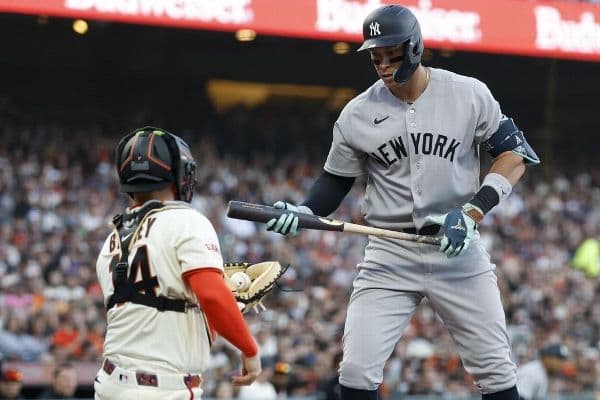
Few players stand to benefit more from the Yankees' use of the ABS system than captain Aaron Judge. At 6-foot-7, Judge has historically faced a unique challenge with the strike zone, as human umpires often struggle to adjust to his massive frame. The ABS system provides a consistent, mathematically defined zone that does not shift based on a player's height or reputation.
The Yankees have utilized the ABS technology to help Judge and his teammates calibrate their eyes to the "true" zone. By reviewing Hawk-Eye data from every plate appearance in practice, the Yankees' hitters have developed a refined sense of which pitches on the black are strikes and which are fractionally outside. This preparation ensures that when Judge is in the box, he isn't guessing; he is operating with a level of certainty that allows him to trigger a challenge the moment a call deviates from the automated standard.
Why the Yankees' Use of the ABS System Creates a Competitive Edge
In the high-pressure environment of the AL East, a single strike can change the trajectory of a series. By treating the ABS system as a skill to be mastered rather than a hurdle to be cleared, the Yankees are minimizing the "human error" factor that can lead to wasted challenges. The team’s strategy focuses on maintaining their challenge count by only appealing calls with a high statistical probability of being overturned.
Success in this new era requires a blend of traditional baseball IQ and a modern understanding of sports technology. Through Boone’s meticulous planning and the players' disciplined execution, the Yankees are proving that the best way to handle the future of baseball is to be the most prepared team in the room. As the season progresses, the ability to correctly challenge a pivotal call without needing a signal from the dugout could very well be the difference between a postseason berth and an early October exit.
Sources & Original Reporting

