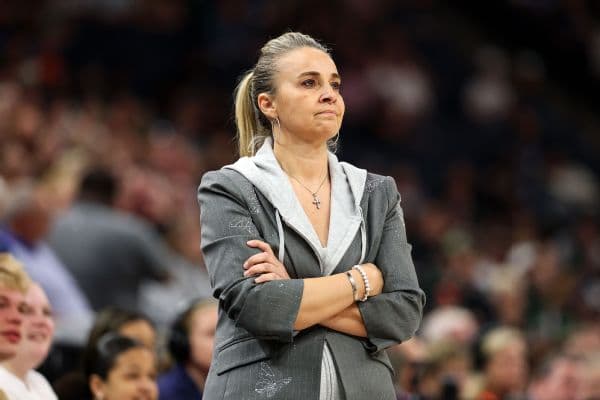
In the world of professional basketball, few voices carry as much weight and tactical authority as Becky Hammon. The Las Vegas Aces head coach and former NBA assistant has never been one to mince words, and her recent Becky Hammon Jalen Brunson comments have once again placed her at the center of a heated NBA debate. Despite the backlash from New York Knicks fans and media pundits alike, Hammon is standing by her assessment of the Knicks’ star point guard while simultaneously leaving the door open for a historic rebuttal.
The controversy began when Hammon suggested that a player of Brunson’s physical stature—listed at 6-foot-2—might struggle to be the number one option on a championship-winning team. In a recent follow-up, Hammon clarified that while she respects Brunson’s incredible skill set, the history of the league supports her skeptical stance. “He’s going to have to prove me wrong,” Hammon stated, doubling down on the statistical rarity of small guards leading their franchises to the ultimate prize.
The Logic Behind the 'Small Guard' Theory
Hammon’s critique isn’t rooted in a dislike for Brunson’s game, but rather in a cold analysis of NBA history. For decades, the league has been dominated by "wings" and "bigs" who serve as the primary engines for title contenders. When looking at the last thirty years of NBA champions, the list of primary scoring options is dominated by names like LeBron James, Kevin Durant, Giannis Antetokounmpo, and Shaquille O'Neal.
During her explanation, Hammon pointed to the exceptions that prove the rule. She noted that while players like Stephen Curry and Isiah Thomas have led teams to championships as smaller guards, they are extreme outliers. Curry, in particular, changed the geometry of the game with his gravity-defying shooting, a trait that Hammon argues is necessary to overcome the physical disadvantages of being a smaller player in a league of giants.
“My point was, if your best player is a small guard, you’re probably not winning a championship,” Hammon explained. She emphasized that the physical toll of a two-month playoff grind often favors larger players who can finish through contact and defend multiple positions more effectively than a 6-foot-2 guard.
Jalen Brunson’s Rise to All-NBA Stature
While Hammon looks at the historical data, Knicks fans point to the present reality: Jalen Brunson has been nothing short of spectacular since arriving in New York. Brunson has transformed the Knicks from a middling Eastern Conference team into a legitimate threat, putting up All-NBA numbers and delivering some of the most clutch performances in recent franchise history.
Since the Becky Hammon Jalen Brunson comments first went viral, Brunson has continued to let his play do the talking. His ability to navigate the paint, use his elite footwork, and draw fouls against much larger defenders has made him one of the most difficult covers in the league. For the Knicks, Brunson isn't just a point guard; he is the heartbeat of the organization, leading the team in scoring, assists, and fourth-quarter usage.
The Knicks' Championship Aspirations
The real test of Hammon's theory will come in the postseason. The Knicks have made aggressive moves to surround Brunson with elite defensive talent and secondary scoring, specifically to mitigate the concerns Hammon raised. By building a roster that features length and versatility, New York hopes to prove that a team led by a smaller guard can indeed hoist the Larry O'Brien Trophy.
- Historical Context: Only a handful of guards under 6-foot-3 have been the undisputed #1 option on a title team.
- Brunson's Impact: Leading the Knicks to back-to-back deep playoff runs and high seeding in the East.
- Hammon's Stance: Highlighting the defensive and physical limitations that often plague small guards in seven-game series.
Open to Being Proven Wrong
Perhaps the most intriguing part of Hammon’s recent statement is her willingness to be corrected by history. As a coach who has broken numerous barriers herself, Hammon understands that greatness often involves defying the odds. She isn't rooting against Brunson; she is simply stating the tactical reality as she sees it from the sidelines.
“I love his game. I love his grit,” Hammon added, acknowledging the intangibles that Brunson brings to the floor. However, in a professional sports landscape driven by matchups and physical advantages, she remains firm that the burden of proof lies with the player. If Brunson can lead the Knicks to a title, he won't just be winning a ring; he'll be dismantling a long-held basketball philosophy held by some of the brightest minds in the sport.
As the NBA season progresses toward the playoffs, every Brunson performance will be viewed through the lens of this debate. Whether Hammon is eventually vindicated or forced to admit she was wrong, the conversation highlights the evolving nature of the modern NBA and the perennial question of how much size truly matters when greatness is on the line.
Sources & Original Reporting