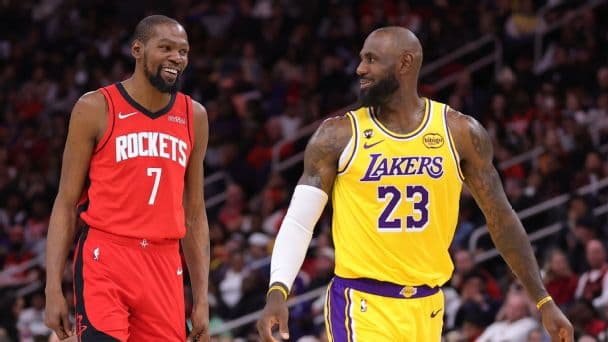
In the modern era of professional basketball, few rivalries have carried as much weight or historical significance as the individual battles between two of the greatest small forwards to ever lace them up. The history of LeBron James and Kevin Durant playoff meetings is a chronicle of the NBA’s evolution over the last 15 years, representing a high-stakes chess match between two generational talents. While their regular-season encounters are always marquee events, it is their three distinct postseason series that have truly defined their legacies and shaped the championship landscape of the league.
The 2012 NBA Finals: A Changing of the Guard in South Beach
The first chapter of the LeBron James and Kevin Durant playoff meetings occurred in June 2012. At the time, LeBron James was under immense pressure to secure his first championship after a decade of dominance without a ring. On the other side, a young Kevin Durant led a homegrown, explosive Oklahoma City Thunder squad that featured future MVPs Russell Westbrook and James Harden. The matchup was billed as a battle for the crown of the best player in the world.
While the Thunder took Game 1 in convincing fashion, the Miami Heat responded with four straight victories to win the series 4-1. LeBron James was transcendent, averaging 28.6 points, 10.2 rebounds, and 7.4 assists per game to earn his first Finals MVP. Despite the loss, Kevin Durant proved he belonged on the biggest stage, leading all scorers in the series with 30.6 points per game on an incredibly efficient 54.8% shooting. This meeting established the blueprint for their rivalry: two unstoppable forces who forced one another to reach new heights of excellence.
The 2017 NBA Finals: The Arrival of the Superteam Era
It would take five years for the two icons to meet again in the postseason, but the context had changed drastically. By 2017, LeBron James had returned to the Cleveland Cavaliers and delivered a historic 2016 title. Meanwhile, Kevin Durant had made the controversial decision to join a 73-win Golden State Warriors team. This second installment of the LeBron James and Kevin Durant playoff meetings was arguably the highest level of offensive basketball ever seen in a Finals series.
Durant was on a mission to secure his first ring, and he did so by outperforming almost everyone in his path. The defining moment of the series came in Game 3, when Durant hit a cold-blooded, go-ahead three-pointer over the outstretched arms of LeBron James in the final minute. The Warriors won the series 4-1, and Durant was named Finals MVP, averaging 35.2 points per game. James was equally historic, becoming the first player to average a triple-double in the NBA Finals (33.6 PPG, 12.0 RPG, 10.0 APG), yet even that wasn't enough to overcome the firepower of Durant and the Warriors.
2018: The Trilogy and the Final Stand in Cleveland
The third and most recent meeting took place just one year later in the 2018 NBA Finals. This series highlighted the sheer individual brilliance of both players under different circumstances. LeBron James was playing some of the most refined basketball of his career, dragging an underdog Cavaliers roster back to the Finals. Kevin Durant, now fully integrated into the Golden State system, was looking to cement a dynasty.
The series is often remembered for LeBron’s Herculean 51-point effort in Game 1, which remains one of the greatest individual performances in playoff history. However, the Warriors’ collective talent, led by Durant’s scoring prowess, eventually overwhelmed Cleveland in a 4-0 sweep. Durant earned his second consecutive Finals MVP, averaging 28.8 points, 10.8 rebounds, and 7.5 assists. These LeBron James and Kevin Durant playoff meetings solidified Durant's place as a multi-time champion and reinforced James' status as a player who could single-handedly keep his team competitive against all-time great rosters.
The Statistical Impact and Historical Significance
When analyzing the total body of work across these three series, the numbers are staggering. In their 14 head-to-head Finals games, both players have consistently raised their scoring averages and efficiency compared to their regular-season marks. Key takeaways from their postseason history include:
- Durant holds the edge in titles: Durant has won two of the three series matchups (2017, 2018), while James won the inaugural meeting in 2012.
- Finals MVP dominance: In every series they have played against each other, the winner of the series also took home the Finals MVP trophy (James in 2012, Durant in 2017 and 2018).
- Efficiency at Scale: Both players have shot over 50% from the field across their combined Finals meetings, a testament to their ability to score against elite defensive schemes specifically designed to stop them.
As we look at the current NBA landscape, the possibility of a fourth meeting remains a tantalizing prospect for fans. Whether it occurs in the Western Conference playoffs or a final championship showdown, the history between LeBron James and Kevin Durant serves as a reminder of an era defined by two players who refused to settle for anything less than greatness. Their matchups haven't just been games; they have been momentous occasions that moved the needle for the entire sport.
Sources & Original Reporting