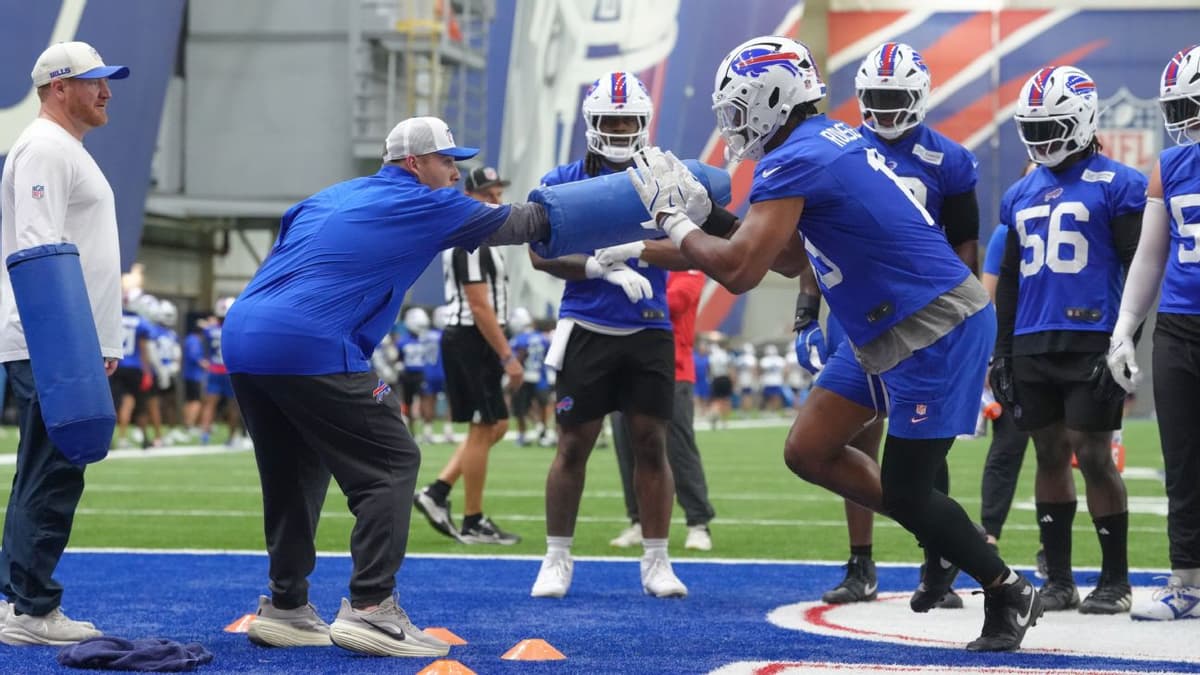
The Buffalo Bills concluded their three-day mandatory minicamp this week, providing the most significant glimpse yet into how the roster is shaping up for the 2024 season. With several veteran pillars no longer in the building, the sessions at Orchard Park were more than just a routine tune-up; they represented the start of a fundamental transition for Sean McDermott’s squad. From a revamped wide receiver room to a reshuffled offensive line, the Buffalo Bills minicamp offered clarity on several high-stakes position battles as the team prepares for the long road to the postseason.
The Offensive Line Strategy: David Edwards Takes the Lead at Left Guard
One of the most pressing questions entering the offseason was how the Bills would replace the veteran presence of Mitch Morse at center. The team’s solution involved moving Connor McGovern from left guard to center, which subsequently opened a massive hole on the left side of the line. Based on the rotations observed during minicamp, David Edwards has emerged as the clear frontrunner to fill that vacancy.
Edwards, who re-signed with the Bills on a two-year deal this offseason, took the vast majority of first-team reps at left guard throughout the week. His familiarity with the system and his previous starting experience with the Los Angeles Rams provide a level of stability that the coaching staff clearly values. While the team experimented with different combinations to build depth, the trio of Dion Dawkins, Edwards, and McGovern appears to be the preferred left-side battery heading into training camp. The coaching staff emphasized that Edwards' physicality and veteran intelligence have allowed the transition to remain seamless thus far, providing Josh Allen with a reliable interior pocket.
James Cook and the Joe Brady Offensive Evolution
Coming off a Pro Bowl season where he recorded 1,122 rushing yards, James Cook remains the focal point of the Buffalo backfield. However, the Buffalo Bills minicamp revealed that offensive coordinator Joe Brady intends to expand Cook’s role even further. The emphasis throughout the three-day session was on Cook’s versatility, particularly as a pass-catcher out of the backfield and occasionally lining up in the slot to create mismatches.
Under Brady’s full-time direction, the offense appears to be leaning into Cook’s explosive playmaking ability. During 7-on-7 and 11-on-11 drills, Cook was a frequent target for Allen on intermediate routes, suggesting the Bills want to utilize him as a primary weapon against linebackers in space. With the departure of high-volume targets in the passing game, Cook’s ability to serve as both a safety valve and a vertical threat will be critical to maintaining the offense's efficiency and keeping opposing defenses off-balance.
A New-Look Wide Receiver Corps Finds Its Rhythm
Perhaps no unit faced more scrutiny during minicamp than the wide receivers. Following the trades and departures of Stefon Diggs and Gabe Davis, the Bills are tasked with replacing over 240 targets from last season. The early returns suggest a "by committee" approach led by a mix of youth and veteran speed.
Keon Coleman
The rookie second-round pick was a constant presence with the first-team offense. His 6-foot-3 frame and massive catch radius were on full display, particularly in red-zone drills where he became a favorite target for Allen. Coleman’s ability to high-point the ball provides a different dimension to the passing game that was missing in previous years.
Curtis Samuel
Samuel’s speed was evident in pre-snap motions and jet sweeps. His history with Joe Brady from their time together in Carolina is proving to be a significant asset, as he has quickly mastered the nuances of the playbook. Samuel is expected to be a "gadget" player who can impact the game from multiple spots on the field.
Khalil Shakir
As the lone returning regular from last year's wideout group, Shakir operated as the reliable veteran presence in the slot. He showed strong chemistry with Allen on broken plays and scramble drills, proving that he is ready to take on a much larger share of the target distribution this fall.
Reshaping the Secondary: The Safety Competition
For the first time in nearly a decade, the Bills' secondary is operating without the legendary tandem of Jordan Poyer and Micah Hyde. This shift has triggered an open competition at the safety position, which was one of the most watched developments of the Buffalo Bills minicamp.
Taylor Rapp
Rapp, who re-signed with the team in March, has solidified himself as one of the definitive starters. He has taken on a vocal leadership role, communicating adjustments to the younger players and ensuring the back end of the defense remains synchronized. His experience in McDermott's scheme gives him a significant edge in the transition.
Mike Edwards and Cole Bishop
The battle for the second safety spot remains the most competitive area of the defense. During minicamp, the reps were split between veteran Mike Edwards and rookie Cole Bishop. Edwards brings ball-hawking experience from his time with the Buccaneers and Chiefs, while Bishop offers elite athleticism and range. Defensive coordinator Bobby Babich utilized multiple packages to test both players, and this competition is expected to be a primary storyline when the team heads to St. John Fisher University for training camp in July.
Looking Ahead to Training Camp
While minicamp provided a strong foundation, the real work begins in late July. The Bills have successfully integrated their newcomers, but the true test of the offensive line's cohesion and the young receivers' ability to beat press coverage will come when the pads go on. For now, the Bills leave minicamp with a clearer vision of their identity in a new era of Buffalo football, focused on versatility and a balanced offensive attack.
Sources & Original Reporting