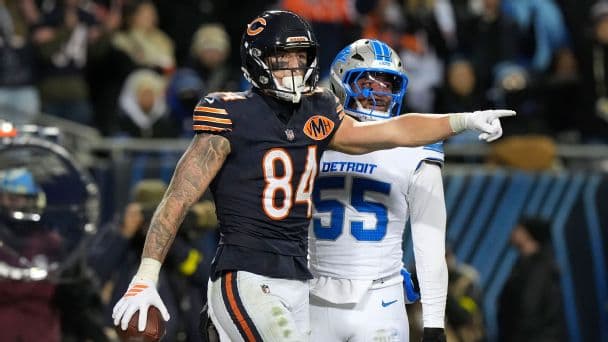
The search for a truly transformative tight end in the Windy City has felt like a decades-long odyssey. From the days of Mike Ditka to the modern reliability of Cole Kmet, the Chicago Bears have often looked for that one singular weapon who could stress every level of a defense. Following the conclusion of the 2025 NFL season, it appears that search is officially over. According to recent league evaluations and a breakout report from ESPN, the Bears Colston Loveland connection has been nothing short of a home run for the franchise.
When General Manager Ryan Poles used the No. 10 overall pick in the 2025 NFL Draft on the Michigan standout, the move was met with a mix of intrigue and skepticism. Drafting a tight end in the top ten is a high-stakes gamble—one that requires the player to be more than just a pass-catcher; they must be a foundational piece of the offensive identity. One year later, Loveland has silenced the critics by delivering a rookie campaign that exceeded even the loftiest expectations in Chicago.
A Strategic Masterstroke in the 2025 NFL Draft
To understand why the Bears Colston Loveland pick is being hailed as a "home run," one must look back at the context of the 2025 off-season. The Bears were entering a pivotal year with quarterback Caleb Williams and a brand-new offensive philosophy under head coach Ben Johnson. Johnson, known for his creative use of tight ends during his tenure with the Detroit Lions, needed a versatile chess piece to make his system sing.
Loveland, standing 6-foot-5 and weighing 245 pounds, was the prototypical fit. During his time at Michigan, he proved to be a refined route-runner with the speed to threaten the seam and the size to dominate in the red zone. The Bears' front office reportedly viewed him as the missing link that would allow Johnson to run the heavy 12-personnel sets (one running back, two tight ends) that had become a staple of his coaching DNA. By pairing Loveland with the established Cole Kmet, Chicago created a vertical mismatch nightmare that few NFL defenses were equipped to handle.
Everything Chicago Could Have Asked For
The transition from college to the NFL is notoriously difficult for tight ends, a position that requires mastering both complex passing trees and high-level blocking assignments. However, Loveland’s rookie season was an anomaly of consistency. He quickly became a favorite target for Caleb Williams, providing a massive catch radius and a reliable "security blanket" on third downs.
The statistical impact was immediate, but the film told an even more impressive story. Loveland showed an elite ability to find soft spots in zone coverage and the physicality to win contested catches against NFL-caliber safeties. His presence on the field forced defensive coordinators to make impossible choices: do you double-team DJ Moore or Rome Odunze, or do you dedicate resources to stopping the 6-foot-5 rookie roaming the middle of the field? More often than not, Loveland made them pay for the latter.
The Ben Johnson Effect
A significant portion of the Bears Colston Loveland success story can be attributed to the scheme. Ben Johnson’s arrival in Chicago brought a modern, aggressive approach to the offense. Johnson utilized Loveland in a variety of roles—aligning him in-line, in the slot, and even out wide as a boundary receiver. This versatility allowed the Bears to dictate personnel matchups before the ball was even snapped.
Reports from within Halas Hall suggest that Loveland’s high football IQ allowed him to absorb the playbook faster than most rookies. This mental acuity meant the coaching staff didn't have to "hide" him or simplify the offense. Instead, they were able to expand the playbook, leading to a breakout season that has now established Loveland as one of the premier young talents at his position.
Looking Toward a Bright Future in Chicago
As the Bears head into the 2026 off-season, the narrative surrounding the team has shifted from "rebuilding" to "contending." The success of the 2025 draft class, headlined by Loveland, has provided the team with a core of young playmakers that can grow alongside Caleb Williams for the next decade. The "home run" designation isn't just about the stats Loveland put up in his first year; it’s about the long-term stability he brings to the roster.
With a full NFL season under his belt and a growing rapport with his quarterback, the sky is the limit for the former Wolverine. If his rookie year was the baseline, the rest of the NFC North should be on high alert. The Chicago Bears didn't just find a starting tight end in Colston Loveland—they found a cornerstone.
Sources & Original Reporting