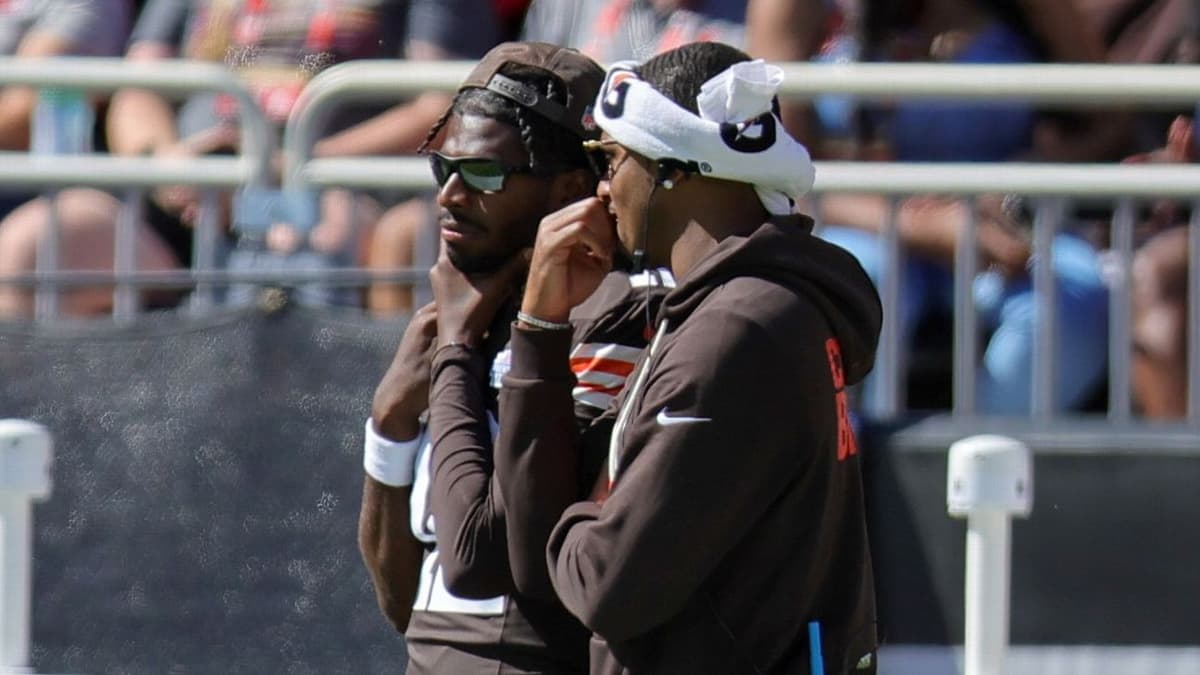
The Cleveland Browns are entering a pivotal phase of their offseason program, and all eyes are firmly fixed on the quarterback room. With a mix of veteran experience and high-upside youth, the Browns QB battle is officially underway. However, those expecting a perfectly symmetrical distribution of snaps during the early stages of the program will be disappointed. Cleveland's coaching staff recently confirmed that repetitions during upcoming offseason workouts will not be divided evenly between Deshaun Watson, Shedeur Sanders, and Dillon Gabriel.
This decision marks a significant departure from traditional "open" competitions where every contender gets an identical slice of the pie. Instead, the Browns are opting for a meritocratic and situational approach, prioritizing the players they believe need specific looks or those who have earned more time with the starting unit. By moving away from a rigid 33-percent split, the coaching staff is signaling that performance, rather than seniority or draft status alone, will dictate the flow of the offseason and the eventual depth chart.
The Philosophy Behind the Browns QB Battle
In the NFL, time is the most valuable commodity. During the limited windows of OTAs and minicamps, coaches must decide whether to give a veteran like Deshaun Watson the time he needs to master a revamped playbook or to accelerate the development of a rookie like Shedeur Sanders. By declaring that reps won't be even, the Browns are acknowledging that each of these three signal-callers is at a different stage of their career and requires a tailored workload to maximize their potential contribution to the team.
For Dillon Gabriel, the challenge is to prove that his collegiate efficiency and high-level production can translate to the professional level. If he shows an early grasp of the system, he may see his share of the reps increase at the expense of the others as the staff looks to see him against more complex defensive looks. The goal is to find the most effective leader for the offense before the team heads to training camp in late July. This "uneven" approach allows the staff to pressure certain players in specific situations, such as two-minute drills or red-zone efficiency, without being beholden to a stopwatch or a set rotation.
Deshaun Watson and the Weight of Expectation
As the most experienced member of the trio, Deshaun Watson enters the spring with a massive spotlight on his shoulders. Despite his veteran status and significant contract, his tenure in Cleveland has been defined by various challenges, making this Browns QB battle more than just a formality. The decision to not guarantee him an equal or majority share of the reps right out of the gate suggests that the coaching staff is fostering a true competitive environment where nothing is handed out based on name recognition alone.
Watson’s familiarity with the organization provides him with a baseline advantage, but the NFL is a league where performance is the only currency that matters. If Watson is to retain his status as the unquestioned starter, he will have to maximize every repetition he is given. The coaching staff will be looking for improved decision-making, better timing with his receivers, and a return to the Pro Bowl-caliber form he displayed earlier in his career. The uneven rep distribution serves as a reminder that the competition is active and the stakes are high.
The Impact of Shedeur Sanders and Dillon Gabriel
The arrival of Shedeur Sanders has injected a new level of excitement into the Browns' facility. As a high-profile addition with a penchant for big plays and a high football IQ, Sanders represents a potential new chapter for the franchise. However, the transition to the NFL is notoriously difficult for young quarterbacks. By not forcing an even split, the Browns can protect Sanders from being overwhelmed while still giving him enough high-quality snaps to gauge his progress against NFL-caliber defenses.
Meanwhile, Dillon Gabriel serves as the intriguing "wild card" in this equation. Known for his mobility and quick release, Gabriel offers a different stylistic look than Watson or Sanders. If the Browns intend to utilize a more RPO-heavy or mobile-quarterback-centric scheme, Gabriel’s reps might increase during specific installation periods. The lack of an even split allows the offensive coordinator to experiment with these different styles without disrupting the overall rhythm of the practice or the development of the other two contenders.
Looking Ahead to Training Camp
The decision to divide reps unevenly now will have massive ramifications for how the depth chart looks when the team arrives at training camp. The player who makes the most of their limited opportunities this spring will likely see a significant bump in first-team snaps come August. This internal pressure is designed to bring out the best in all three athletes, ensuring that whoever wins the Browns QB battle is battle-tested and ready for the rigors of the AFC North.
Ultimately, the Browns are prioritizing wins and offensive cohesion over equal playing time in practice. By being transparent about the rep distribution, the coaching staff is setting a tone of accountability and competition. Whether it is the veteran Watson, the rookie Sanders, or the newcomer Gabriel, the message is clear: every snap is earned, not given. Fans and analysts alike will be watching closely as the hierarchy under center begins to take shape in the coming weeks, providing a glimpse into the future of the Cleveland offense.
Sources & Original Reporting