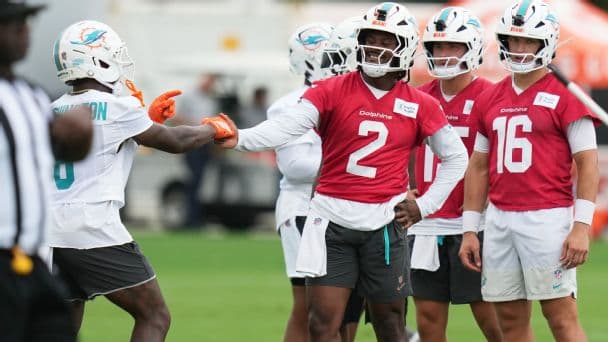
The Miami Dolphins are entering a bold new chapter this summer, one defined by a total philosophical shift and a complete roster transformation. Gone are the days of high-priced superstars and immediate Super Bowl expectations; in their place is a young, hungry roster focused on long-term sustainability. At the center of this movement is the developing rapport between the Dolphins WR group and new signal-caller Malik Willis.
As the team takes the field for summer workouts, the atmosphere in Miami is noticeably different. Following the departure of former pillars like Tyreek Hill and Jaylen Waddle, the Dolphins have fully committed to an offseason overhaul. While some may view the lack of established stars as a hurdle, head coach Jeff Hafley sees it as a blank canvas. The focus is no longer on managing egos, but on building a cohesive unit from the ground up.
A New Hierarchy: Life After the Offseason Overhaul
The decision to move on from veteran playmakers signaled a definitive "full rebuild" for the franchise. This transition has cleared the way for a new-look Dolphins WR group to emerge, led by a collection of players looking to prove they can be the foundation of Miami's future. Without a clear-cut veteran hierarchy, every rep in practice carries immense weight.
Coach Jeff Hafley has been vocal about his lack of concern regarding the current state of the depth chart. To Hafley, the summer is about identifying which players possess the consistency and football IQ to thrive in his system. The absence of a "WR1" label allows for a more egalitarian approach to the passing game, where the ball goes to the open man rather than a forced target.
Malik Willis: The New Face of the Franchise
The arrival of Malik Willis as the team's new quarterback is the linchpin of this rebuild. Willis brings a dual-threat capability that forces defenses to account for both his arm and his legs. However, the success of this new era depends heavily on his ability to find a rhythm with his young receivers. Building chemistry with a completely revamped Dolphins WR group is a meticulous process that requires hours of film study and extra work after practice.
Willis has been praised by the coaching staff for his leadership during these early stages. He is frequently seen working on timing routes with his targets, ensuring that the nuances of ball placement are perfected. For a quarterback in a new system, these summer sessions are the foundation upon which the regular season will be built.
Key Figures in the Dolphins WR Group
With the superstar era in the rearview mirror, three players have emerged as the primary focal points of the Miami passing attack. Their development will be the barometer for the team's offensive success in 2026:
- Malik Washington: A dynamic young talent who has quickly become a favorite target for Willis. Washington’s agility and ability to create separation in the short-to-intermediate game make him a perfect fit for the new offensive scheme.
- Jalen Tolbert: Bringing a blend of size and physicality, Tolbert provides Willis with a reliable target on the perimeter. His ability to win 50/50 balls will be crucial for a young quarterback looking for a safety valve.
- Tutu Atwell: Known for his elite speed, Atwell serves as the primary vertical threat. His presence stretches the defense, opening up underneath lanes for Washington and the tight ends.
Behind this trio, players like Caleb Douglas are fighting for roster spots, adding a layer of healthy competition to the room. The lack of a settled hierarchy has turned every practice into a high-stakes audition, which is exactly what the coaching staff intended.
Jeff Hafley’s Vision for the Rebuild
Coach Jeff Hafley is not interested in quick fixes. His approach to the Dolphins WR group reflects a desire to build a team that can compete for years to come. By prioritizing youth and versatility, Hafley is creating an environment where players are forced to grow together. The chemistry being built between Willis and his receivers isn't just about the 2026 season; it's about establishing a culture of work and accountability.
"We're in the building phase," Hafley noted recently, emphasizing that the team is focused on the process rather than immediate results. This patient approach is a departure from Miami's recent history, but it is one that the organization believes will lead to more sustained success in the long run.
As the summer progresses, the eyes of the NFL will be on South Beach to see if this gamble pays off. If Malik Willis can continue to solidify his connection with Washington, Tolbert, and Atwell, the Miami Dolphins may find themselves ahead of schedule in their rebuilding efforts. For now, the focus remains on the practice field, one repetition at a time.
Sources & Original Reporting