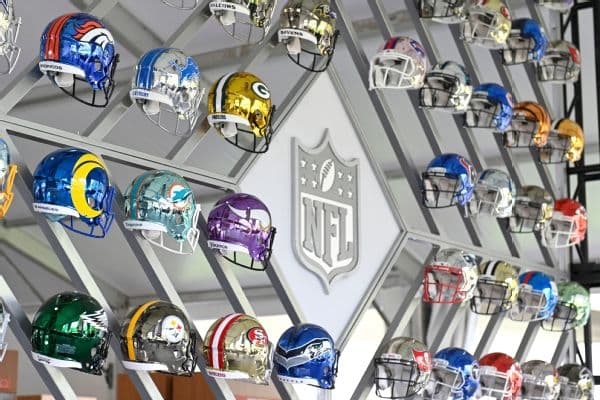
The NFL is taking another significant step in its ongoing commitment to player safety by turning its attention to a component of the helmet that has remained largely unchanged for decades. In a new initiative aimed at further protecting athletes, the league is officially challenging innovators, engineers, and manufacturers to develop improved facemasks designed specifically to reduce the frequency and severity of concussions on the field.
The Search for Improved Facemasks in the NFL
While helmet technology has advanced rapidly over the last several years—introducing position-specific models and enhanced outer shells—the facemask has often been viewed as a rigid secondary component. However, the NFL now recognizes that the facemask plays a critical role in how energy is transferred during a collision. By seeking improved facemasks that can better absorb impact, the league hopes to add a vital layer of protection to the modern football helmet.
The NFL Facemask Challenge is a call to action for the global innovation community. The league is looking for designs that maintain the necessary structural integrity to protect a player’s face from direct contact while incorporating materials or mechanical structures that can dampen the force of an impact. This move follows a series of data-driven safety improvements that have seen concussion rates fluctuate as the league implements stricter protocols and better equipment.
Addressing the Impact of Rigid Materials
Historically, facemasks have been constructed from high-strength steel, titanium, or carbon steel. While these materials are excellent at preventing facial fractures and dental injuries, their rigidity means that when a player makes contact with the ground or another player, the energy of that impact is often transferred directly through the helmet and into the player's head. The goal of the new initiative is to find a middle ground: a mask that is strong enough to protect the face but flexible or "crushable" enough to dissipate energy.
According to league data, a significant portion of head impacts involve contact with the facemask. By redesigning this specific component, the NFL believes it can significantly reduce the "G-forces" experienced by a player’s brain during those high-velocity collisions. This focus on the front of the helmet complements recent advancements in shell technology and internal padding systems that have already been implemented across the league.
A New Frontier in NFL Helmet Technology
The push for improved facemasks is part of the NFL’s broader "Play Smart. Play Safe." initiative. In recent years, the league has shared extensive data from sensors embedded in players' helmets, which has allowed manufacturers to identify exactly where and how hits occur. This data led to the introduction of the Guardian Cap during training camps and the development of helmets tailored specifically for offensive and defensive linemen, who experience different types of impacts than quarterbacks or wide receivers.
By opening the door to new facemask designs, the NFL is encouraging the use of non-traditional materials and additive manufacturing, such as 3D printing. These technologies could allow for complex geometries within the facemask that act as shock absorbers. If successful, these new designs could be integrated into the next generation of helmets as early as the upcoming seasons, providing a comprehensive safety solution from the outer shell to the internal liner and the frontal mask.
The Path Forward for Player Safety
The NFL's commitment to reducing head injuries remains a top priority for the league's medical and engineering advisors. Jeff Miller, the NFL’s executive vice president of communications, public affairs, and policy, has frequently emphasized that the league will continue to use every tool at its disposal to make the game safer. This challenge represents a proactive approach, seeking solutions from outside the traditional sports equipment industry to bring fresh perspectives to a complex problem.
As innovators submit their designs, the NFL will subject the prototypes to rigorous laboratory testing. These tests simulate the various types of impacts players face on the gridiron, ensuring that any new facemask not only reduces concussion risk but also meets the high standards for facial protection that players require. The result of this challenge could fundamentally change the look and feel of the NFL helmet, marking a new era where every inch of a player's gear is optimized for maximum safety.
Sources & Original Reporting