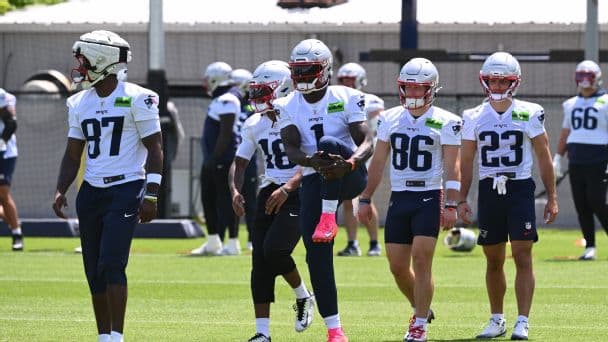
As the New England Patriots prepare to descend upon Foxborough for training camp, the atmosphere surrounding the team is one of cautious optimism and intense competition. Under the new leadership of head coach Jerod Mayo and the arrival of high-profile rookie quarterback Drake Maye, every position group is under the microscope. However, no unit faces a more complex numbers game than the New England Patriots wide receiver roster. With a blend of seasoned veterans, explosive second-year players, and promising rookies, the coaching staff faces a difficult decision: just how many pass-catchers can they afford to keep on the final 53-man roster?
Troy Brown Evaluates the Crowded Receiver Room
Former Patriots legendary wide receiver and current coach Troy Brown recently shared his insights into the current state of the position group. Brown, who knows better than anyone what it takes to succeed in the New England system, acknowledged that this is perhaps the most crowded the wide receiver room has been in recent memory. The depth provides a safety net for a team looking to revitalize an offense that struggled for consistency last season.
According to Brown, the evaluation process during training camp will be rigorous. The team is not just looking for raw talent; they are looking for versatility, reliability, and the ability to create separation. While the league often sees teams carry five or six receivers, Brown hinted that the sheer volume of talent currently in the building could force the Patriots to consider keeping seven wideouts to ensure they don't lose valuable assets to the waiver wire.
The Drake Maye Factor and Offensive Identity
The development of Drake Maye is the primary storyline of the 2024 season. For a rookie quarterback to succeed, he needs a diverse array of targets who can win in different areas of the field. This necessity heavily influences the New England Patriots wide receiver roster construction. The team needs a mix of reliable possession receivers, vertical threats, and players who can generate yards after the catch.
During his evaluation, Brown noted that having a deep rotation allows the offense to stay fresh and provides Maye with various looks during practice and preseason games. While New England may not currently possess a singular dominant force like an AJ Brown, the collective depth is designed to create mismatches through scheme and volume. The goal is to provide Maye with enough options to find the open man, regardless of the defensive coverage.
Key Competitors and the 53-Man Roster Crunch
The battle for the final roster spots will likely come down to special teams contributions and specific niche roles. While players like Kendrick Bourne and DeMario Douglas are viewed as locks, the rest of the depth chart is wide open. The competition includes:
- Ja'Lynn Polk: The high-draft pick expected to provide immediate contested-catch ability.
- Javon Baker: A rookie with the potential to be a deep-threat playmaker.
- K.J. Osborn: A veteran presence brought in to provide stability and veteran leadership.
- Tyquan Thornton: The speedster looking to prove he can stay healthy and consistent.
- JuJu Smith-Schuster: A veteran looking to bounce back after a productive but injury-hampered first year in New England.
With so many names vying for limited spots, the margin for error is razor-thin. Troy Brown emphasized that the "bottom of the roster" players must prove they can contribute on fourth down, much like players in other successful systems, such as Romeo Doubs in Green Bay, who earned his keep through consistent route running and special teams reliability.
Why Seven Receivers Might Be Necessary
Historically, the Patriots have been conservative with roster spots, often favoring extra defensive backs or offensive linemen. However, the modern NFL's shift toward 11-personnel (three wide receivers) as a base formation makes a deep receiver room more of a necessity than a luxury. If the Patriots decide to keep seven receivers, it would likely come at the expense of a spot at linebacker or on the defensive line.
The logic behind keeping seven is simple: protection against injury and the preservation of young talent. If the Patriots believe that their seventh receiver—perhaps a developmental rookie or a special teams ace—would be claimed by another team immediately upon being waived, they may find a way to squeeze them onto the 53-man roster. As Troy Brown suggested, the talent level this year might just be high enough to justify that rare roster configuration.
What to Watch for in Training Camp
As camp progresses, fans should keep a close eye on how the repetitions are distributed. If the team consistently rotates seven different players with the first and second-string offenses, it’s a strong signal that they are seriously considering the expanded depth. The preseason games will be the ultimate litmus test, where these receivers will have to prove their worth not just as targets for Maye, but as foundational pieces of the new-look Patriots offense.
Ultimately, the New England Patriots wide receiver roster will be a reflection of the team's commitment to supporting their young quarterback. Whether they keep six or seven, the competition in Foxborough is set to be one of the most compelling stories of the summer.
Sources & Original Reporting