There was a time in the National Hockey League when the formula for success was simple: find a legendary netminder, start him for 70 games, and ride him until the wheels fell off in the postseason. Icons like Martin Brodeur, Patrick Roy, and Ed Belfour were the iron men of the crease, rarely seeing the bench except for the occasional blowout. However, that era has officially vanished into the history books. In the modern era, NHL goalie tandems have transitioned from a regular-season luxury to a mandatory playoff strategy.
As the league evolves into a faster, higher-scoring, and more physically demanding environment, the concept of the "workhorse" goaltender is becoming an endangered species. Teams are no longer looking for one savior; they are building depth charts that feature two capable starters, often referred to as a "1A/1B" system. This shift isn't just about resting veterans; it’s a calculated tactical evolution designed to ensure peak performance when the stakes are highest.
The Decline of the 70-Game Starter
To understand why NHL goalie tandems are so prevalent today, one only needs to look at the workload statistics over the last two decades. In the early 2000s, it was common to see multiple goaltenders surpass the 70-game mark. Today, a goalie reaching 60 starts is considered a heavy lifter. The physical toll of the modern game—characterized by lateral explosive movements and constant traffic in the crease—makes it nearly impossible for a single player to maintain elite consistency over an 82-game schedule and four rounds of playoffs.
Front offices across the league have realized that a fresh goaltender at 90% capability is often more effective than a fatigued superstar at 75%. This realization has led teams like the Carolina Hurricanes and the Minnesota Wild to embrace a strict rotation, keeping both netminders engaged and sharp throughout the grueling winter months.
Why NHL Goalie Tandems Provide a Competitive Edge
The rise of the tandem system is driven by more than just injury prevention; it is about tactical flexibility. Different goaltenders bring different styles to the ice. A team might prefer a massive, positional blocker for a matchup against an opponent that shoots from the perimeter, while opting for a smaller, more athletic "scrambler" against a team that excels at cross-seam passes and high-danger chances.
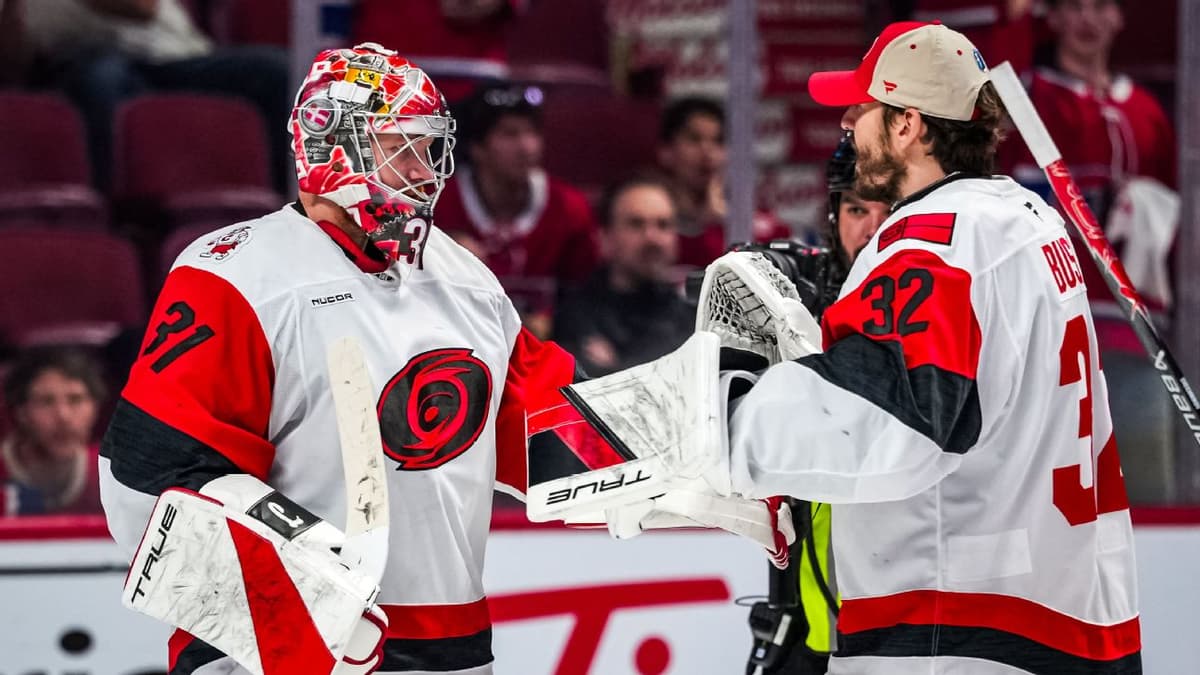
The Carolina Hurricanes have been the poster child for this approach. By utilizing a rotation of Pyotr Kochetkov and Frederik Andersen, they ensure that neither goalie is overtaxed. This strategy allows the coaching staff to play the "hot hand" or choose the goalie whose style best counters the opposition’s offensive scheme. Similarly, the Vegas Golden Knights proved the efficacy of depth during their 2023 Stanley Cup run, where they successfully navigated injuries by having multiple NHL-caliber starters ready to step in at a moment's notice.
Tactical Flexibility and Injury Mitigation
Injuries are an inherent risk in professional hockey, but the goaltending position is particularly vulnerable to lower-body ailments. By employing NHL goalie tandems, teams mitigate the catastrophic impact of a single injury. When the Colorado Avalanche or the Edmonton Oilers look at their depth charts, they are no longer searching for a backup who can merely survive a few starts; they are looking for a partner who can win a playoff series.
In Edmonton, the duo of Stuart Skinner and Calvin Pickard has shown how a tandem can provide stability. When one struggles or needs a mental break, the other is prepared to take the reins without a significant drop-off in team performance. This internal competition often pushes both players to improve, creating a healthy dynamic that benefits the entire locker room.
The Playoff Pivot: From One Starter to Two
The most significant change in philosophy has occurred during the Stanley Cup Playoffs. Historically, coaches were terrified of changing goalies in the postseason, fearing it would signal a lack of confidence. Today, the "short leash" is a standard tool. If a starter falters in Game 1, coaches no longer hesitate to turn to their 1B option for Game 2.
Teams like the Buffalo Sabres, who are developing young talents like Ukko-Pekka Luukkonen and Devon Levi, are building their future around this dual-threat model. The goal is to arrive at the postseason with two healthy, confident options. We are seeing a trend where the goalie who starts the playoffs isn't necessarily the one who finishes them—and in the modern NHL, that is no longer seen as a crisis, but as a sign of elite roster construction.
As we look toward the future of the league, the workhorse goalie may never truly return. The speed of the game and the precision of modern shooters demand a level of focus and physical output that necessitates rest. The 1A/1B system is here to stay, and the teams that master the art of the tandem are the ones most likely to be hoisting the Stanley Cup in June.
Sources & Original Reporting