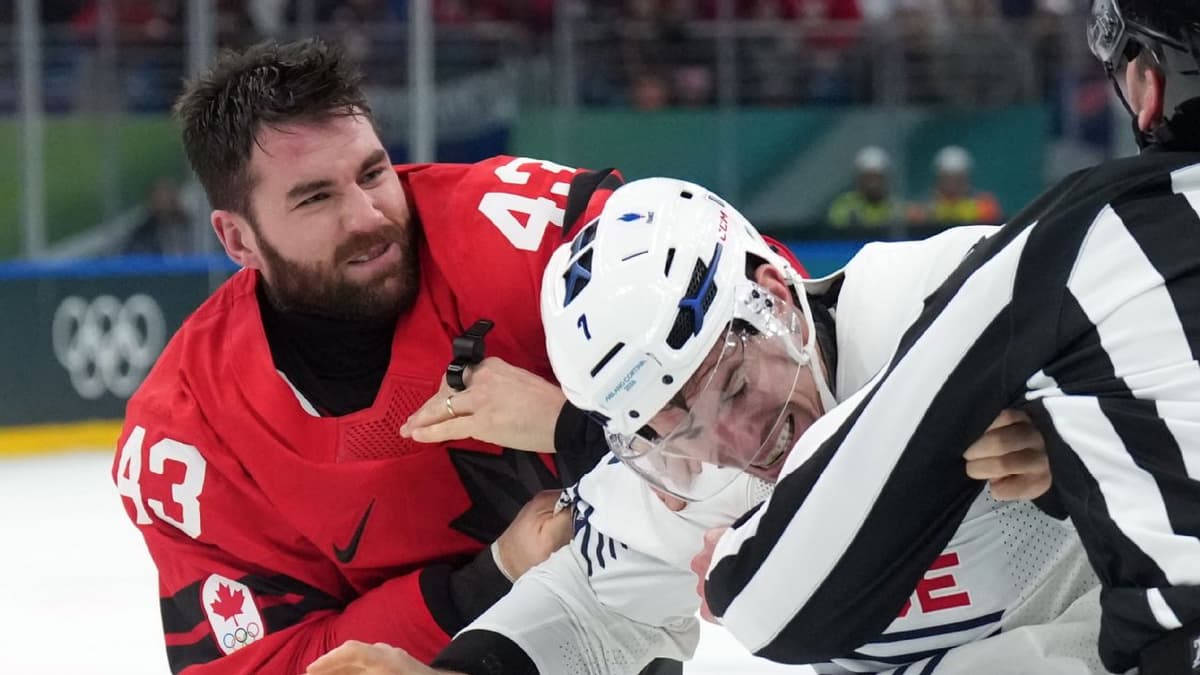
International hockey is often celebrated for its fluid skating and high-octane skill, but Tom Wilson reminded the world that the NHL’s brand of physical accountability still has a place on the global stage. During a preliminary round matchup against France on Sunday, the Tom Wilson Olympic hockey fight became the talk of the tournament after the veteran forward dropped the gloves to defend superstar teammate Nathan MacKinnon.
The Incident: Nathan MacKinnon Targeted
The tension began to simmer midway through the contest between Canada and France. Nathan MacKinnon, one of the premier talents in the world and a cornerstone of the Canadian roster, was the recipient of a dangerous hit. A French player delivered a forearm directly to the head of MacKinnon, a play that immediately drew the ire of the Canadian bench and those watching in the arena.
While MacKinnon remained in the game, the message from the opposition was clear: they intended to play a physical, disruptive style against Canada’s top-tier talent. In the fast-paced environment of Olympic hockey, where rules regarding contact are often stricter than in the NHL, the hit stood out as a significant breach of player safety.
Tom Wilson Drops the Gloves
Known for his physical presence and role as a protector with the Washington Capitals, Tom Wilson did not let the hit on his teammate go unanswered. Late in the third period, with the game’s outcome largely decided, Wilson found the opportunity to address the earlier transgression. The Tom Wilson Olympic hockey fight occurred as he engaged the player responsible for the hit on MacKinnon.
Fights are an extreme rarity in international play. Under IIHF (International Ice Hockey Federation) rules, fighting typically results in an automatic game misconduct and often carries the threat of further suspensions. Wilson’s decision to drop the gloves was a calculated move to stand up for Canada's leading scorer, prioritizing team chemistry and player protection over his own availability for the remainder of the game.
The Rarity of Fighting in Olympic Hockey
The Tom Wilson Olympic hockey fight is significant because of how infrequently such events occur during the Winter Games. While the NHL has a long-standing tradition of players "policing" the game, the international stage operates under a different set of standards. The IIHF has historically taken a zero-tolerance approach to fighting, aiming to keep the focus on speed and technical ability.
However, when NHL players are involved in the Olympics, the intensity often mirrors that of the Stanley Cup Playoffs. Wilson’s actions highlight the clash between the traditional European style of play and the North American philosophy of physical deterrence. By defending MacKinnon, Wilson sent a clear signal to the rest of the field that Canada’s stars would not be targeted without consequence.
Impact on Team Canada
While the immediate result of the fight was Wilson’s departure from the ice, the long-term impact on the Canadian locker room is likely positive. In a short tournament like the Olympics, building a cohesive unit is essential. Seeing a veteran like Wilson sacrifice his playing time to defend a teammate can serve as a rallying point for a squad looking to secure gold.
Canada continues its march through the group stage, but the physical nature of the game against France suggests that the road to the podium will be as much about grit as it is about skill. Nathan MacKinnon remains the engine of the Canadian offense, and thanks to the Tom Wilson Olympic hockey fight, opponents may think twice before taking liberties with Canada’s top players in the knockout rounds.
Sources & Original Reporting