In the high-stakes world of the pre-draft process, the 40-yard dash is often treated as the ultimate litmus test for a wide receiver's potential. However, Ohio State star Carnell Tate is challenging that narrative. During the Ohio State Pro Day on Wednesday, Tate made the calculated decision to skip the 40-yard dash, opting instead to let his previous numbers and game film speak for themselves. The move has sparked a wider conversation about how much weight NFL front offices should place on track speed versus functional football speed.
The Decision to Skip the 40-Yard Dash
As scouts and coaches from across the NFL descended upon Columbus, all eyes were on Carnell Tate. After a productive career with the Buckeyes, Tate entered the draft cycle as one of the most polished route-runners in his class. Having already posted a time at the NFL Scouting Combine earlier this spring, Tate decided there was little to gain by running again on his home turf.
When asked why he chose not to participate in the sprint, Tate was blunt about his reasoning. He noted that he felt his previous time was sufficient and that the drill itself often receives more attention than it deserves. In his view, the Carnell Tate NFL Draft profile is built on much more than a straight-line sprint in spandex. By standing on his combine numbers, Tate signaled a confidence in his overall athletic profile that many prospects lack during the high-pressure Pro Day environment.
Why Carnell Tate Believes the Metric is "Overvalued"
The most striking takeaway from the day was Tate’s critique of the scouting process. He explicitly labeled the 40-yard dash as "overvalued," a sentiment that is becoming increasingly common among modern athletes who prioritize "GPS speed"—the speed measured during actual gameplay while wearing pads and navigating defenders.
"It can be overvalued," Tate remarked during his media availability. His argument centers on the idea that wide receivers rarely run 40 yards in a straight line without interference in a real NFL game. Instead, Tate emphasized the importance of short-area quickness, acceleration out of breaks, and the ability to maintain speed while tracking a ball in the air. For Carnell Tate, the obsession with a specific decimal point in a track drill can sometimes overshadow the nuances of the wide receiver position.
Focusing on Positional Drills and Route Running
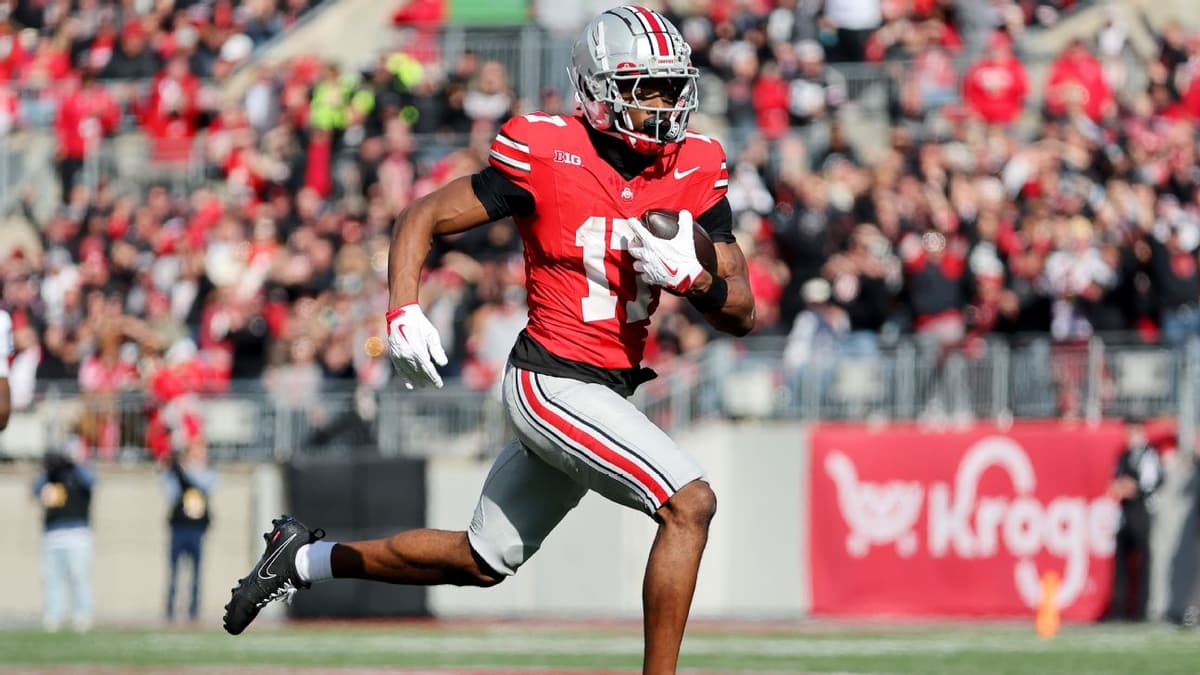
While he bypassed the timing gates, Tate was far from a spectator at the Ohio State Pro Day. He participated fully in positional drills, showcasing the fluid hips and precise footwork that made him a favorite target in the Ohio State offense. NFL scouts watched closely as he ran a variety of routes, from sharp 10-yard outs to deep post patterns, demonstrating his ability to create separation against air.
By focusing on these drills, Tate aimed to prove that his value lies in his technical proficiency. The Ohio State University has a long-standing reputation for producing "pro-ready" receivers, and Tate appeared determined to uphold that legacy. His performance in the receiving gauntlet and individual route sessions served as a reminder that while he may not be chasing track records, his 40-yard dash speed is more than enough to be a vertical threat at the next level.
Impact on Carnell Tate's NFL Draft Stock
The decision to skip a major drill can sometimes be a red flag for scouts, but in Tate's case, the consensus seems to be that it won't hurt his standing. Most draft analysts currently project him as a high-round selection, thanks in large part to his consistent production in the Big Ten. NFL teams are increasingly using advanced analytics to supplement traditional combine data, and Tate’s game speed has consistently ranked among the best in the nation.
Furthermore, the Buckeyes' track record with wide receivers gives Tate a certain level of benefit of the doubt. With former teammates like Marvin Harrison Jr. and Emeka Egbuka finding immediate success in the league, scouts are often more willing to trust the "Ohio State pedigree" over a single workout metric. As the draft approaches, Carnell Tate remains one of the most intriguing prospects at his position, precisely because he is willing to prioritize his on-field identity over off-field measurements.
Looking Ahead to the NFL Draft
With his Pro Day now in the rearview mirror, Tate will shift his focus to individual team visits and private workouts. His stance on the 40-yard dash has certainly made him a talking point, but his tape remains his strongest resume builder. As NFL teams finalize their boards, they will have to decide if they agree with Tate’s assessment that the stopwatch is secondary to the scoreboard.
Whether his comments lead to a shift in how teams evaluate speed remains to be seen, but for now, Carnell Tate is comfortable with the player he has put on film. In a league that is constantly evolving, Tate’s preference for "football speed" over "track speed" might just be the forward-thinking approach that modern NFL offenses are looking for.
Sources & Original Reporting