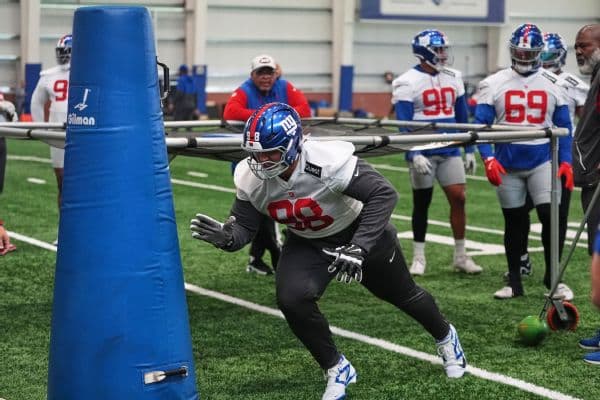
The New York Giants’ offseason preparations took a devastating turn this week as the team lost a projected key contributor to their defensive front. Veteran defensive lineman Roy Robertson-Harris reportedly suffered a torn Achilles during Thursday’s Organized Team Activity (OTA) workout. The Roy Robertson-Harris Achilles injury is expected to sideline him for the entire 2026 NFL season, a source told ESPN.
A Significant Blow to Defensive Depth
The injury occurred during a non-contact portion of the Giants' spring program, a period designed for installation and conditioning rather than high-impact collisions. Despite the controlled environment of OTAs, the sudden nature of the injury serves as a stark reminder of the physical toll of professional football. For the Giants, losing a player of Robertson-Harris' caliber before June is a significant setback for a unit looking to establish dominance in the trenches.
Robertson-Harris was brought in to provide a veteran presence and versatility to the interior of the defensive line. At 6-foot-5 and over 290 pounds, his ability to slide between the defensive end and tackle positions made him a valuable asset for defensive coordinator schemes. His absence creates an immediate void in the rotation that the Giants will need to address before training camp begins in July.
The Road to Recovery: The Impact of the Roy Robertson-Harris Achilles Injury
An Achilles tendon tear is widely regarded as one of the most difficult injuries for an NFL athlete to overcome, particularly for defensive linemen who rely on explosive power and the ability to drive off their back foot. The recovery timeline typically spans nine to twelve months, involving surgery followed by a rigorous rehabilitation process to regain calf strength and fast-twitch mobility.
Given the timing of the injury in late May, the 2026 season is effectively over for the veteran. The focus for Robertson-Harris will now shift toward a potential return in 2027. For players in their 30s, these types of injuries carry additional weight, as maintaining the necessary athleticism to compete at the NFL level becomes an even greater challenge during a long layoff.
How the Giants Adjust Without Robertson-Harris
With Robertson-Harris out of the equation, the Giants' front office and coaching staff must pivot quickly. The team has built its defensive identity around a strong interior, led by All-Pro talent, but the depth behind the starters is now under a microscope. The coaching staff will likely look at a combination of internal development and external reinforcements to bridge the gap.
Internal Development
Younger players on the roster will see an immediate uptick in snaps during the remaining OTAs and upcoming mandatory minicamp. This is a critical opportunity for developmental prospects to prove they can handle a rotational role. The Giants have invested draft capital in the defensive line over recent years, and those players must now accelerate their learning curve to provide the necessary relief for the starters.
Free Agency Market
While the primary waves of free agency have passed, there are often veteran defensive linemen available who are looking for a one-year deal to fill a specific need. General Manager Joe Schoen may look to add a proven commodity to stabilize the room. Finding a veteran who can replicate Robertson-Harris' leadership and versatility will be a priority as the team nears the summer break.
Scheme Adjustments
The defensive staff may need to alter their sub-packages, potentially relying on more edge-heavy looks or different blitz packages if they cannot find a direct replacement for Robertson-Harris' specific skill set. Flexibility will be key, and the Giants may experiment with different personnel groupings to mask the loss of their veteran interior presence.
Veteran Leadership and the 2026 Outlook
Beyond his physical production on the field, Roy Robertson-Harris was expected to be a leader in the locker room. His experience across multiple teams in the league provided a blueprint for younger players on how to approach the professional game. Losing that veteran voice on the field during the heat of the season is a loss that statistics cannot fully capture.
The Giants entered the 2026 offseason with the goal of fortifying their defense to compete in a highly competitive NFC East. While the loss of Robertson-Harris is a hurdle, the team must maintain its "next man up" philosophy. The health of the remaining defensive line now becomes paramount, as the margin for error has significantly narrowed following this week's unfortunate news.
As the Giants continue their OTA schedule, the medical staff will work closely with Robertson-Harris on his initial recovery steps. Meanwhile, the rest of the roster will have to step up to ensure the defensive front remains a position of strength heading into the 2026 campaign.
Sources & Original Reporting