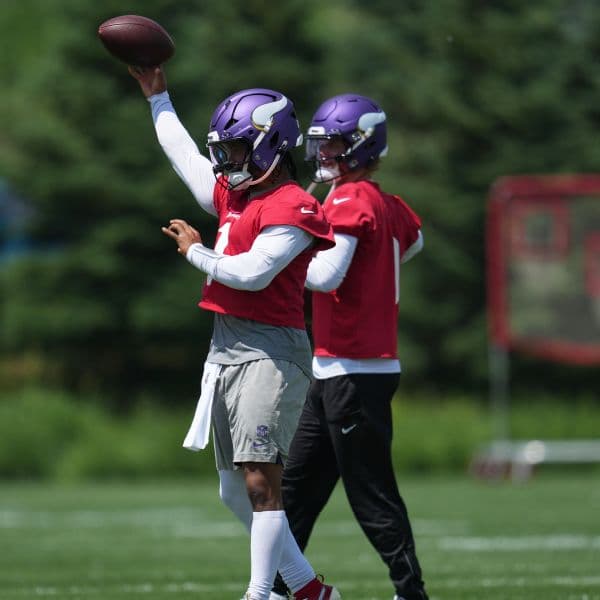
The arrival of Kyler Murray in the Twin Cities has signaled a massive shift for the Minnesota Vikings franchise, but the transition from the desert to the Midwest hasn't been without its hurdles. As the team progresses through its offseason program and prepares for the rigors of the regular season, Murray is finding that the most significant challenge isn't the change in climate or the new surroundings, but rather the limited time available to master a brand-new offensive system. Kyler Murray's transition to the Minnesota Vikings has become one of the most watched storylines of the NFL offseason.
Speaking to the media about his integration into the Vikings' culture, Murray was candid about the difficulties of a high-stakes quarterback competition. After spending the entirety of his professional career with the Arizona Cardinals, the former No. 1 overall pick is now navigating a landscape where every snap is scrutinized and shared among a deep depth chart. The adjustment period has been complicated by the team's commitment to a competitive environment where no position is handed out based on resume alone.
The Quest for More Repetitions
According to Murray, the most difficult part of the transition to Minnesota has been the distribution of practice snaps. In Arizona, Murray was the undisputed focal point of the offense, receiving the lion's share of first-team repetitions throughout his tenure. In Minnesota, head coach Kevin O'Connell has implemented a structure where Murray must split time with other signal-callers as the team evaluates its best path forward.
Overcoming the Shared Huddle
"The most difficult part of the transition... has been splitting reps with J.J. McCarthy and the rest of the Vikings quarterbacks as part of the competition," Murray stated. For a veteran quarterback, rhythm and timing are essential. When those elements are disrupted by a rotation of players, the learning curve for a new playbook becomes significantly steeper. Murray emphasized that more consistent time on the field would help ease the friction of learning a new scheme and building chemistry with his new teammates. The lack of volume in practice makes it harder to reach the level of comfort necessary to lead a high-octane NFL offense.
The Dynamic of the Vikings Quarterback Competition
The Minnesota Vikings find themselves in a unique position with a blend of proven veteran talent and established young assets. By bringing in Murray, the team signaled a desire for an elite playmaker who can extend plays with his legs and stretch the field vertically. However, the presence of J.J. McCarthy, who is now entering his third season with the franchise, creates a dual-track development plan that requires careful management from the coaching staff.
McCarthy's Third-Year Growth
Unlike a standard veteran-rookie dynamic, McCarthy is now an experienced member of the roster. Having been drafted in 2024, the former first-round pick has two full years of NFL experience under his belt and a deep understanding of O'Connell's terminology. This creates a legitimate competition where Murray is playing catch-up on the playbook while McCarthy provides a level of continuity. This internal battle for the starting role means that neither player is currently getting the full volume of work usually afforded to a clear-cut starter during the offseason phases.
Adapting to Kevin O’Connell’s Offensive Philosophy
Beyond the physical reps, the mental transition to Kevin O’Connell’s system is a significant undertaking. The Vikings' offense relies heavily on precision, intermediate passing windows, and complex pre-snap reads. While Murray possesses the elite athleticism to bail out a broken play, the goal in Minnesota is to operate within the structure of the system to maximize the talents of stars like Justin Jefferson and Jordan Addison.
Building Critical Timing with Pass Catchers
Murray’s desire for more reps stems from a professional need to see these concepts play out against a live defense. In the NFL, there is no substitute for live-action experience when it comes to internalizing a new playbook. The nuances of O'Connell's scheme—such as the specific timing of a deep crosser or the footwork required for a play-action bootleg—can only be perfected through repetition. Without a consistent flow of snaps, the connection between Murray and his receivers remains in its early, experimental stages.
Looking Ahead to Training Camp
As the Vikings move closer to the start of the season, the focus will remain on how the coaching staff manages the workload between Murray and McCarthy. The veteran quarterback remains confident in his abilities, but he is clear about what he needs to reach peak performance: more time under center. The transition is a work in progress, and while the talent is undeniable, the logistical challenges of a split-rep camp remain the primary hurdle for Minnesota’s newest star.
Key areas the Vikings will focus on as camp continues include:
- Establishing a clear hierarchy for first-team repetitions.
- Increasing Murray's comfort level with pre-snap adjustments.
- Ensuring both Murray and McCarthy receive enough volume to stay sharp.
- Evaluating the chemistry between the quarterbacks and the primary receiving corps.
For the Vikings, the hope is that this competitive environment will eventually lead to a settled depth chart where the starter can finally take the reins and command the full volume of the offense. Until then, Kyler Murray will continue to push for the opportunities he needs to make the Minnesota offense his own and complete his transition to the NFC North.
Sources & Original Reporting