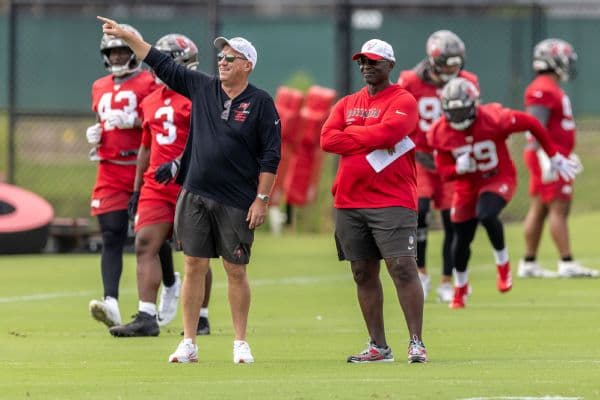
The Tampa Bay Buccaneers have hit a speed bump in their offseason preparations. Head coach Todd Bowles confirmed on Thursday that the team was forced to forfeit a scheduled Organized Team Activity (OTA) session this week due to a violation of league rules regarding practice intensity. The Tampa Bay Buccaneers OTA penalty resulted in the cancellation of Wednesday's practice, a move mandated by the NFL after a review of previous sessions.
According to Bowles, the issue stemmed from the level of physicality displayed during the team's non-contact drills. In the NFL's Phase 3 of the offseason, while players are permitted to wear helmets and engage in team drills, live contact is strictly prohibited. The goal is to focus on installation, timing, and conditioning without the risk of injury associated with full-speed collisions.
Understanding the Tampa Bay Buccaneers OTA Penalty
The specific reason cited for the Tampa Bay Buccaneers OTA penalty was that there were "too many guys on the ground." In NFL parlance, this indicates that the intensity of the drills led to players falling or being knocked down, a clear sign that the contact exceeded the "no-live-contact" mandate. Todd Bowles addressed the situation with transparency, acknowledging that the league's oversight found the team’s sessions to be too aggressive for the current phase of the calendar.
The NFL and the NFL Players Association (NFLPA) take these violations seriously. Under the Collective Bargaining Agreement (CBA), teams are required to film all OTA sessions and provide that footage to the league for review. This monitoring ensures that teams are not gaining an unfair competitive advantage by practicing more intensely than allowed, and more importantly, it protects the health and safety of the players during the long offseason.
The Rules of NFL Offseason Workouts
To understand why the Buccaneers were penalized, it is essential to look at the structure of the NFL offseason program. The program is divided into three distinct phases:
- Phase 1: Limited to strength and conditioning and physical rehabilitation only.
- Phase 2: Includes on-field workouts, individual player drills, and "perfect play" drills, but no live contact or team-on-team drills.
- Phase 3: Includes OTAs and mandatory minicamp. Teams can conduct 7-on-7, 9-on-7, and 11-on-11 drills, but no live contact is permitted.
The Buccaneers were in the midst of Phase 3 when the league intervened. When players end up on the ground during these sessions, it suggests that the "thud" tempo—where players wrap up but do not take teammates to the ground—has escalated into full-speed tackling. For a veteran-heavy team like Tampa Bay, maintaining this balance is crucial, yet sometimes the competitive nature of the roster can lead to these infractions.
The Impact on Team Development
Losing a day of practice might seem minor in the grand scheme of a 17-game season, but for a team in transition, every repetition is vital. The Tampa Bay Buccaneers OTA penalty comes at a time when the offense is attempting to master a new system under offensive coordinator Liam Coen. After the departure of Dave Canales, Coen has been tasked with evolving the playbook for quarterback Baker Mayfield and the rest of the unit.
For Mayfield, who recently signed a significant contract extension to remain the face of the franchise, these early summer days are about building chemistry with his receiving corps, including stars like Mike Evans and Chris Godwin. Missing a day of on-field work disrupts the rhythm of that installation process. While the team can still hold meetings and review film, the loss of live-speed execution on the grass is a setback that the coaching staff will have to manage carefully as they move toward mandatory minicamp.
Todd Bowles and the Defensive Mindset
It is perhaps no surprise that a team coached by a defensive specialist like Todd Bowles would struggle to turn down the intensity. Bowles has long preached a physical, aggressive style of play. However, as a head coach, he is also responsible for administrative compliance. Bowles noted that while he appreciates the effort and the hunger of his players, they must remain within the boundaries set by the league.
"You want the guys to be aggressive, but you have to be smart," Bowles indicated. The challenge for the Buccaneers moving forward will be to maintain that "dog" mentality without crossing the line that leads to further league intervention. Repeated violations can lead to more severe consequences, including heavier fines for both the head coach and the organization, and the loss of additional practice days or even future draft picks.
Looking Ahead to Training Camp
With the Wednesday practice now behind them and the penalty served, the Buccaneers returned to the field on Thursday to continue their work. The focus will now shift toward ensuring that the remaining OTA sessions and the upcoming mandatory minicamp are conducted within the legal limits of the CBA. The coaching staff will likely be extra vigilant in monitoring the "thud" tempo to ensure that no more players end up on the ground prematurely.
As the team nears the end of the spring program, the goal remains the same: to enter training camp in July with a firm grasp of the playbook and a healthy roster. The Tampa Bay Buccaneers OTA penalty serves as a stern warning from the league office, but for a team with Super Bowl aspirations, it is also a testament to the high-energy environment Bowles is fostering in Tampa. The key will be channeling that energy correctly when the pads finally come on in late July.
Sources & Original Reporting